
Only 9% of Latvian Companies Do Not Face a Skills Shortage
Nine out of ten Latvian companies are currently forced to adapt to a situation where the labour market can no longer provide all the skills they need, according to a survey of medium-sized and large companies commissioned by OP Corporate Bank*. To reduce the impact of this challenge, companies are investing in employee skills development, process automation and more efficient ways of organising work.
Companies Are Increasingly Investing in Their People
The shortage of qualified labour is not a new challenge for Latvian companies. Already in last year’s study**, 75% of Latvian companies indicated that the shortage of qualified labour and required skills was one of the main factors affecting their business development outlook.
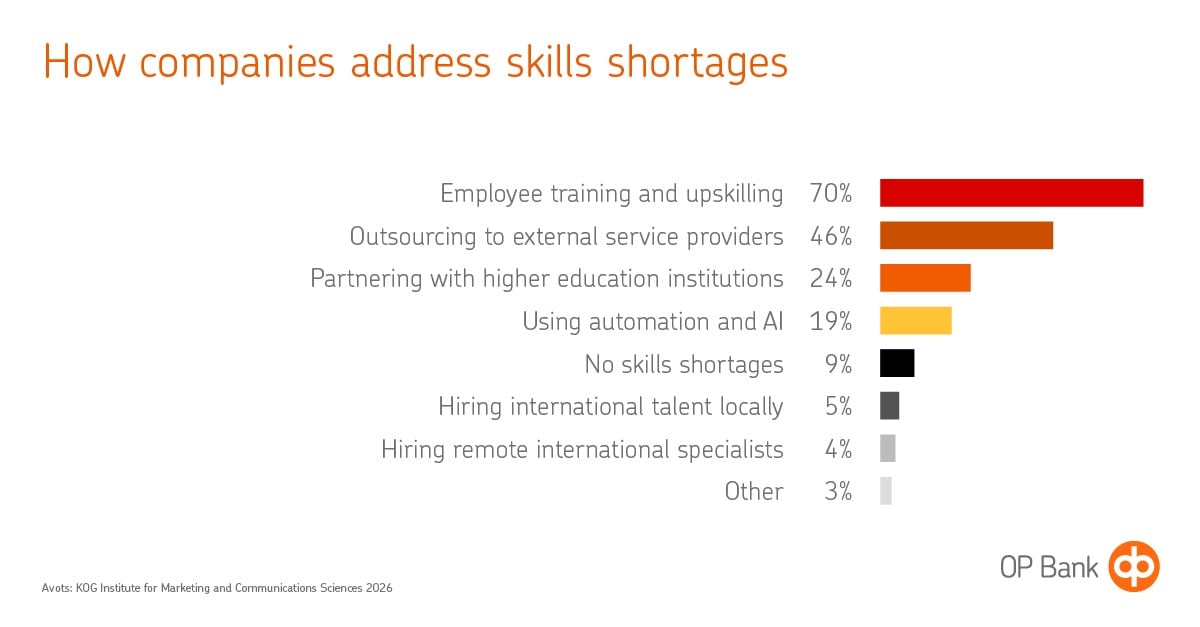
The latest survey shows that companies are increasingly adapting to the situation by developing the skills of their employees. Seven out of ten companies (70%) organise internal training or reskill employees to help them adapt to changing business needs. Nearly half of companies (46%) secure the necessary competencies through outsourcing providers, while 24% cooperate with higher education institutions to prepare the specialists they need.
"For several years, the labour market in Latvia has been tight, and companies have found it difficult to recruit specialists with the required skills. Moreover, demographic trends suggest that the situation is unlikely to improve in the coming years. At the same time, technological development is advancing so rapidly that upskilling employees has become a continuous process. Continuous competence development is an essential prerequisite for long-term competitiveness, and skilled teams enable companies to adapt more successfully to change," says Elmārs Prikšāns, General Manager of OP Corporate Bank plc Latvia Branch.
Productivity Becomes More Important Than the Number of Employees
Companies’ decision to invest in developing the skills of their existing employees is in line with broader trends in the Latvian economy. The Latvian Productivity Report 2025 states that long-term economic growth will increasingly depend on the ability to improve productivity, implement innovations and make more efficient use of human capital.
At the same time, the think tank LaSER’s study Latvia 2040: Demographic Reality and Future Scenarios forecasts that the number of working-age people in Latvia will continue to decline over the coming decades. This means that companies will increasingly need to grow not through larger numbers of employees, but through higher productivity.
Automation Becomes an Everyday Solution
Companies are increasingly using technology to reduce the impact of labour shortages. Survey data show that one in five Latvian companies (19%) uses automation and artificial intelligence solutions. Although this approach is currently less common in Latvia than in Lithuania and Estonia, technology is becoming an increasingly important tool for improving productivity and reducing the impact of labour shortages.
"The shortage of labour is encouraging companies to invest more actively in automation and technology. In the manufacturing sector, this often means automation of production processes, while in the services sector it involves investments in IT solutions and process efficiency improvements. However, technology does not completely eliminate the need for people, as demand is growing for highly qualified employees who are able to manage and develop increasingly complex technologies. It is important for companies to develop not only the competencies required today, but also to prepare in advance for the skills that will be needed in the future," emphasises E. Prikšāns.
Baltic Companies Choose Different Approaches
While 9% of Latvian companies indicate that they do not face a shortage of employee skills, this figure is only 1% in Lithuania and 2% in Estonia, indicating that skills shortages are even more widespread in neighbouring countries.
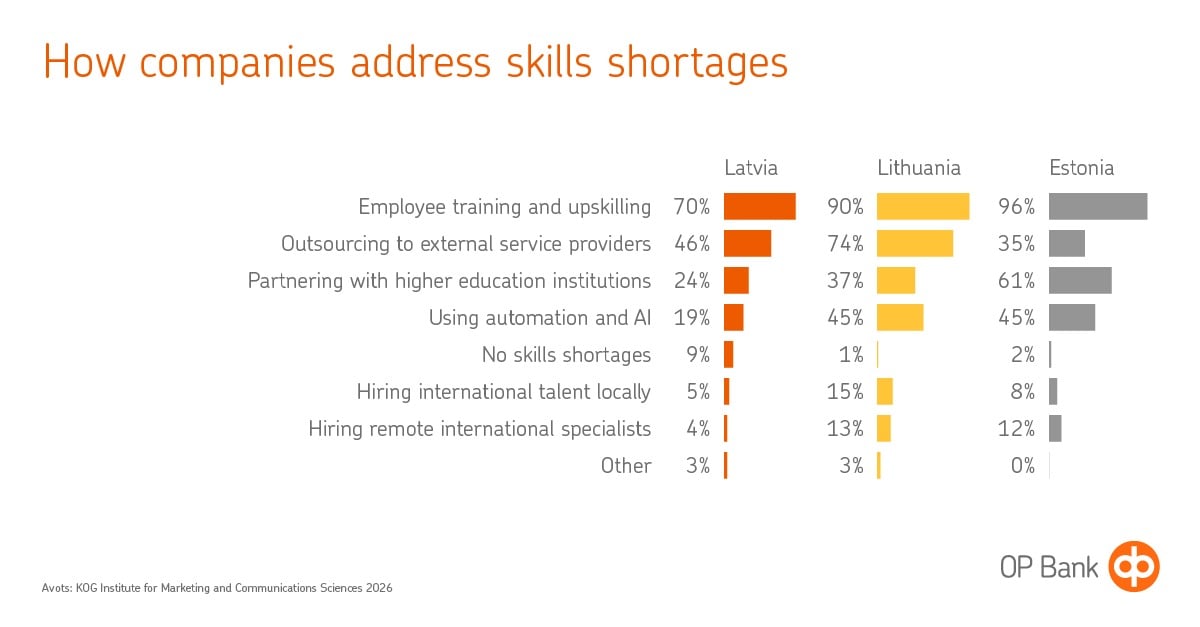
In all three countries, the most common approach to addressing skills shortages is the development of existing employees’ skills. This approach is used by 70% of companies in Latvia, 90% in Lithuania and 96% in Estonia.
Outsourcing is particularly widespread in Lithuania, where 74% of companies choose this approach; in Estonia, cooperation with higher education institutions is chosen more often than in the other countries (61%).
Automation and artificial intelligence solutions to mitigate skills shortages are used by almost half (45%) of companies in both Lithuania and Estonia, compared with 19% in Latvia.
The survey results show that companies across all Baltic countries address skills shortages by combining several approaches: employee skills development, outsourcing, cooperation with educational institutions and the implementation of technological solutions.
* The survey was commissioned by OP Corporate Bank and conducted by the market research and communication sciences institute KOG Institute for Marketing and Communications Sciences in April 2026, surveying more than 300 representatives of medium-sized and large companies across the Baltics.
** The survey was commissioned by OP Corporate Bank and conducted by the market research company Rait in February 2025, surveying more than 300 representatives of companies from various industries across the Baltics.
About OP Corporate Bank plc Latvia Branch
OP Corporate Bank plc is the central bank of OP Pohjola, Finland’s largest financial services provider. It started operations in Latvia in 2012 and is currently one of the leading banks in Latvia by the volume of loans granted to medium-sized and large corporates. OP Corporate Bank plc Latvia Branch provides financial services to leading companies in Latvia and plays a significant role in the long-term development of both the country and the wider region.