
Survey: Latvian businesses more concerned about shortage of skilled labour than geopolitical instability
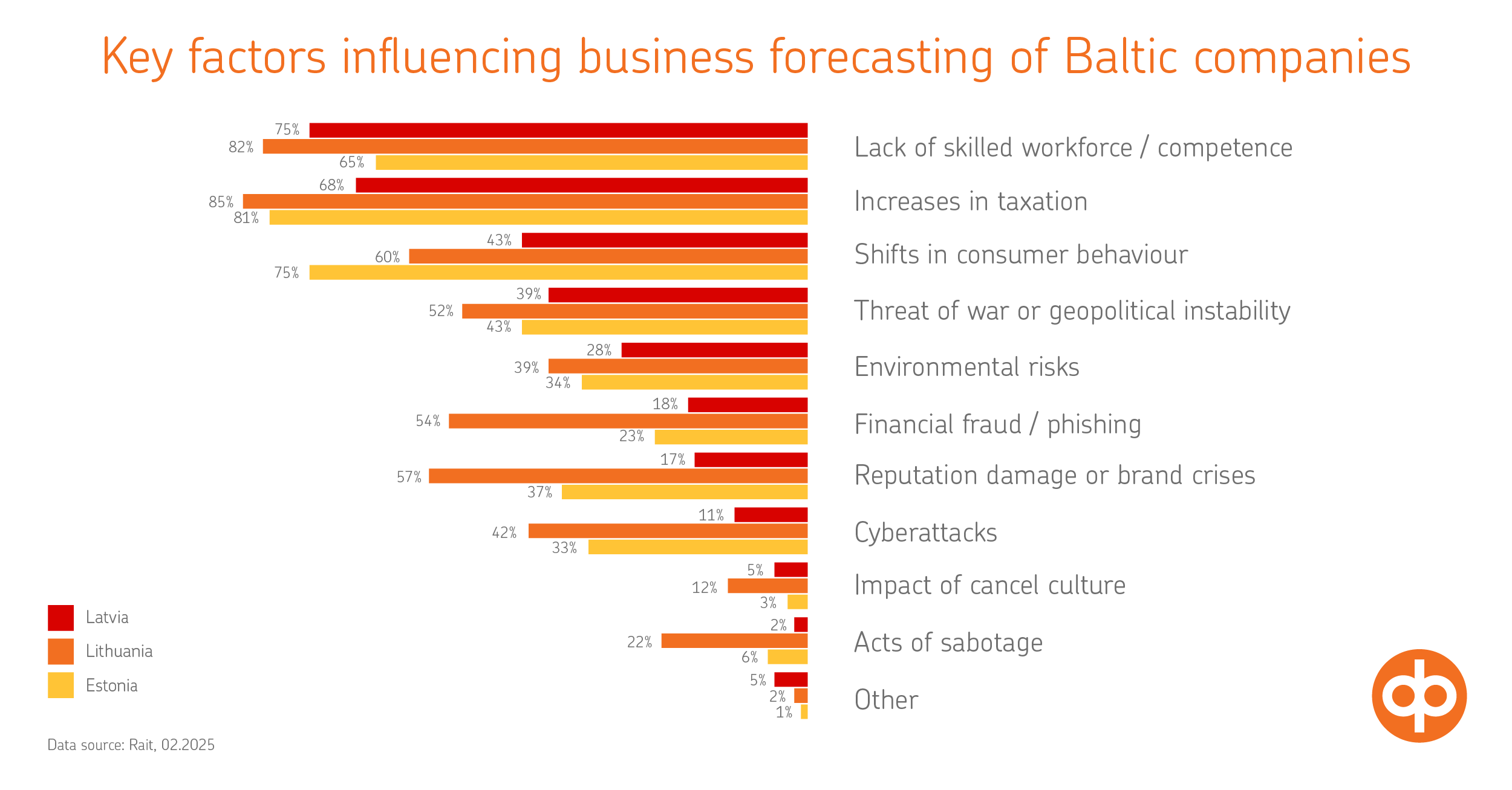
As they plan their future business, Latvian entrepreneurs are more concerned about a shortage of skilled labour than geopolitical instability, OP Corporate Bank’s survey of Baltic companies shows*. The shortage of skilled labour affects the future plans of 75% of Latvian, 82% of Lithuanian and 65% of Estonian companies.
“The labour market has remained relatively strong across the Baltics. According to our group’s economists, the unemployment rate in Latvia is lower than in the two other Baltic states. Therefore, despite the slowdown of economic growth, in recent years, Latvia has felt the shortage of skilled labour the most. This significantly impacts business development, limiting growth opportunities in labour-intensive sectors. At the same time, it encourages businesses to invest, particularly in the areas of process automation and digitalisation, which reduces the need for labour,” says Elmārs Prikšāns, General Manager of OP Corporate Bank plc Latvian branch.
He adds: “We see that some Latvian entrepreneurs are already actively starting to introduce various artificial intelligence tools in their everyday operations, and in the future, this sector definitely has the potential to promote the growth and efficiency of businesses, as well as to replace some of the missing workforce.”
While Latvian companies are concerned mainly about the workforce, in neighbouring countries, entrepreneurs are most likely to focus on the increase in the tax burden when planning for the future – this was pointed out by 85% of entrepreneurs in Lithuania and 81% in Estonia. In Latvia, slightly more than half of the surveyed entrepreneurs (68%) are concerned about the increase in taxes. “It is important to note that at the beginning of this year, both Lithuania and Estonia were affected by tax changes. For example, in Lithuania, corporate income tax was increased by one per cent, while in Estonia, among many other taxes, both corporate and personal income taxes were raised, and from 1 July, the value added tax will also be increased,” explains E. Prikšāns.
Geopolitical situation not among top three concerns
Although the geopolitical situation is currently particularly unpredictable and complex, entrepreneurs are more concerned with other issues. In Latvia, the threat of war and geopolitical instability as a risk factor in planning business operations was identified by just over a third of the surveyed companies (39%), the lowest rate in the Baltics – in Lithuania, about half (52%) pay attention to this, and in Estonia, 43% of companies. In Latvia, the geopolitical situation is only the fourth factor affecting the entrepreneurs’ future plans – the entrepreneurs find the shortage of skilled labour, tax increases and changes in consumer behaviour more important.
Environmental risks - climate change and natural disasters, which affect more than a quarter or 28% of Latvian entrepreneurs' future plans, are in fifth place. Compared to the other Baltic countries, Latvian entrepreneurs are less likely worried about these risks than entrepreneurs in Lithuania (39%) and Estonia (34%).
Reputational, fraud and cyber security risks are less of a concern in Latvia
Financial fraud, reputational risks and cyber-attacks are also among the major risks that entrepreneurs take seriously in their business planning. Interestingly, these risks are perceived very differently in each of the Baltic states. For example, Lithuanian entrepreneurs are clearly more concerned about reputational risks and brand crises, as they were mentioned by 57% of the respondents, while in Estonia this is a concern for 37% of entrepreneurs, and in Latvia only for 17% of entrepreneurs.
Financial fraud and cyber-attacks are not among the most important factors bothering Latvian entrepreneurs – in Latvia, financial fraud worries less than a fifth of entrepreneurs, or 18%, and just 11% are concerned about cyber-attacks. Meanwhile, Lithuanian entrepreneurs find these factors much more important, with more than half of them stressing the risks of financial fraud and 42% the possibility of cyber-attacks. In Estonia, these figures were 23% and 33% of entrepreneurs, respectively.
E. Prikšāns stresses that the business environment is becoming increasingly dynamic, and the risks companies face are becoming more complex and changeable: “In the future, companies will inevitably need to adapt and look for new opportunities, not only to grow and develop, but also to manage their risks effectively. Those who will manage to successfully adapt to these changes and find innovative solutions, will have the opportunity to become more sustainable and competitive both on the domestic and international markets.”
* The survey, commissioned by OP Corporate Bank, was carried out by market research company Rait, surveying more than 300 representatives of companies from various sectors in Latvia, Lithuania and Estonia in February 2025.