
Sustainability in Business and Changes to ESG Regulation: How Are Baltic Companies Responding?
Despite the European Commission’s planned changes to sustainability reporting regulation and the simplification of requirements, the majority of large and medium-sized companies in the Baltics have already implemented or started implementing environmental, social and governance (ESG) requirements, according to data from an OP Corporate Bank plc customer survey.* A clear sustainability strategy supports investor confidence and access to capital.
Latvian Businesses Are Not Waiting for Regulatory Changes – They Are Acting Now
In spring 2025, the European Commission introduced the ESG regulatory simplification package, known as the Omnibus package, providing for the postponement of sustainability reporting deadlines and a reduction in administrative burden, while maintaining the alignment of ESG objectives with the implementation of the European Green Deal. Sustainability reporting standards are currently under review, the volume of required data is being reduced, and the EU sustainable finance framework is being further developed to more effectively channel capital flows towards sustainable growth.
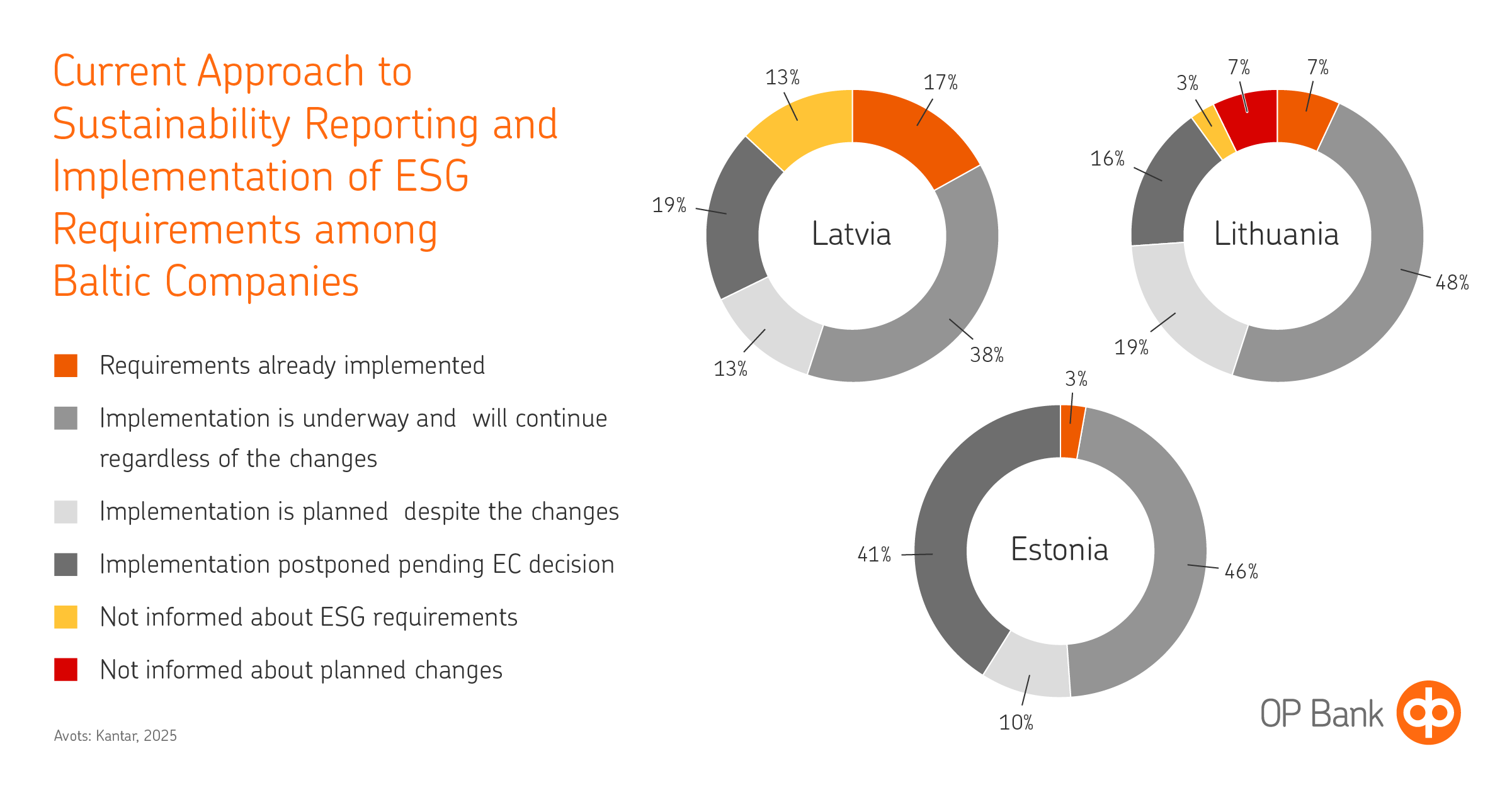
In addition, it was confirmed in February this year that mandatory sustainability reporting will apply to a significantly smaller number of large companies. For some large companies, reporting will not be required before 2027–2028. However, survey results show that Baltic companies are continuing on their chosen sustainability path. According to the data, 38% of Latvian companies have already started implementing sustainability requirements and plan to continue regardless of the planned regulatory changes, while 17% have already fully implemented these requirements. One fifth (19%) have chosen to temporarily postpone implementation while awaiting the European Commission’s final decision.

“ESG principles help companies identify potential environmental and social risks at an early stage, strengthen good governance and become more resilient in the long term. Moreover, companies increasingly view sustainability principles as an integral part of long-term planning and development rather than merely a formal regulatory requirement. Businesses that already today integrate responsibility towards people, the environment and good governance into their development planning strengthen their value, investor confidence and access to capital, even in uncertain times,” says Elmārs Prikšāns, General Manager of OP Corporate Bank plc Latvia Branch.
Estonian Companies More Likely to Wait, While Nearly Half of Lithuanian Companies Have Already Implemented ESG
Different approaches to the implementation of sustainability principles can be observed across the Baltic states. In Lithuania, almost half of the surveyed companies (48%) have already started implementing ESG and plan to continue despite potential regulatory changes. In Estonia, companies are acting more cautiously – although the majority (46%) have also started implementing the requirements, a significantly higher share of companies (41%) than in Latvia (19%) and Lithuania (16%) have chosen to wait for the European Commission’s final decision.
The survey results show that companies in the Baltics are currently in a transition phase – most are actively implementing sustainability requirements, while a smaller share prefers to wait for regulatory clarity. The overall trend indicates that sustainability remains high on corporate agendas, as only a small proportion of companies in Latvia (13%) and Lithuania (6%) admit that they are not informed about ESG principles and requirements.
The Finnish Perspective – ESG as Both a Challenge and a Competitive Opportunity
While the European Commission is considering easing sustainability reporting requirements, the OP Pohjola Large Corporates Survey** shows that ESG regulation is having a tangible impact on business in Finland. Nearly half of large Finnish companies believe that sustainability reporting consumes so many resources that it reduces investments in specific sustainability activities. One year earlier, this view was expressed by only one third of respondents.
Furthermore, due to ESG requirements, 40% of large companies expect to change subcontractors or suppliers in the near future. Approximately half of the companies planning such changes indicate that they will most significantly affect Finnish small and medium-sized enterprises acting as subcontractors and suppliers to large companies.
At the same time, nearly half of respondents believe that the US administration’s critical stance on sustainability could strengthen the competitiveness and market position of European companies, for example in green and clean transition markets.
* The survey was conducted by research agency Kantar in autumn 2025, surveying 130 representatives of large and medium-sized companies across all three Baltic states.
** The OP Pohjola annual Large Corporates Survey conducted in autumn 2025 included 139 representatives of large Finnish companies.
About OP Corporate Bank plc Latvian Branch
OP Corporate Bank plc is the central bank of OP Pohjola, Finland’s largest financial services provider. The bank began operations in Latvia in 2012 and is currently one of the leading banks in Latvia by the volume of loans issued to medium‑sized and large enterprises. OP Corporate Bank plc Latvian branch provides financial services to leading companies in Latvia and plays a significant role in the long‑term development of the country and the wider region.