
27% of companies in Latvia still see no measurable benefits from artificial intelligence and automation
Artificial intelligence (AI) technologies are becoming increasingly common in the daily operations of Baltic companies, but their use does not always translate into measurable business results. In Latvia, almost one-third (27%) of medium-sized and large companies indicate that AI and automation have not delivered measurable benefits over the past year, compared with 10% in Lithuania and 15% in Estonia, according to a survey of businesses conducted by OP Corporate Bank.* Finnish companies face a similar challenge. Although the country is one of the European leaders in AI adoption, only 15% of the large companies surveyed are able to reliably measure the impact of AI on business results.**
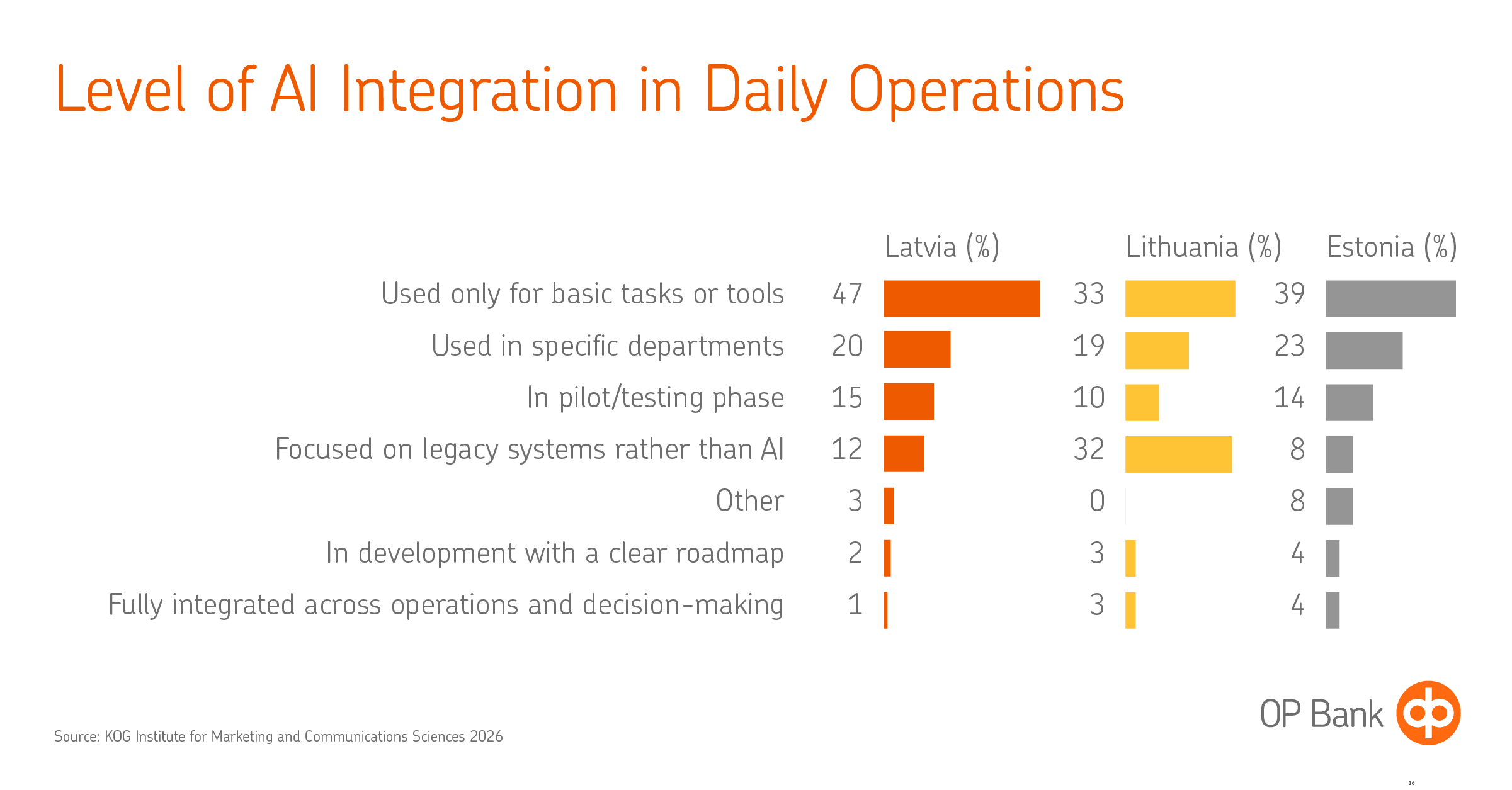
AI is becoming increasingly established in the daily operations of Latvian companies, gradually evolving from a tool supporting individual functions into a technology used more broadly across different work processes. In 2025, only 27% of the Latvian companies surveyed indicated that they used AI in their operations at all.*** At the time, it was most commonly used in marketing, data analysis and reporting, customer service and sales, while currently almost half of companies (47%) already use AI solutions for basic tasks. A further 20% of Latvian companies use AI in specific business units, while 15% are currently in the piloting or testing phase of AI solutions.
AI has also become an everyday work tool in the neighbouring countries, as indicated by 33% of the surveyed companies in Lithuania and 39% in Estonia. However, there is still a long way to go before AI is fully integrated into companies’ operations. Only 1% of Latvian companies indicate that AI is fully integrated into the company’s processes and decision-making. In Lithuania and Estonia, the respective shares are 3% and 4%.
“The first stage of artificial intelligence adoption has already begun in many companies. Employees are using various tools, individual tasks are being automated and new solutions are being tested. The next and more difficult question is whether the company can turn this technology into measurable business value. Time savings are a good start, but in the long term, investments in AI should also be reflected in productivity, costs, customer experience, the quality of decision-making or new revenue,” says Elmārs Prikšāns, General Manager of OP Corporate Bank plc Latvia branch.
Benefits provided by AI differ across the Baltic countries
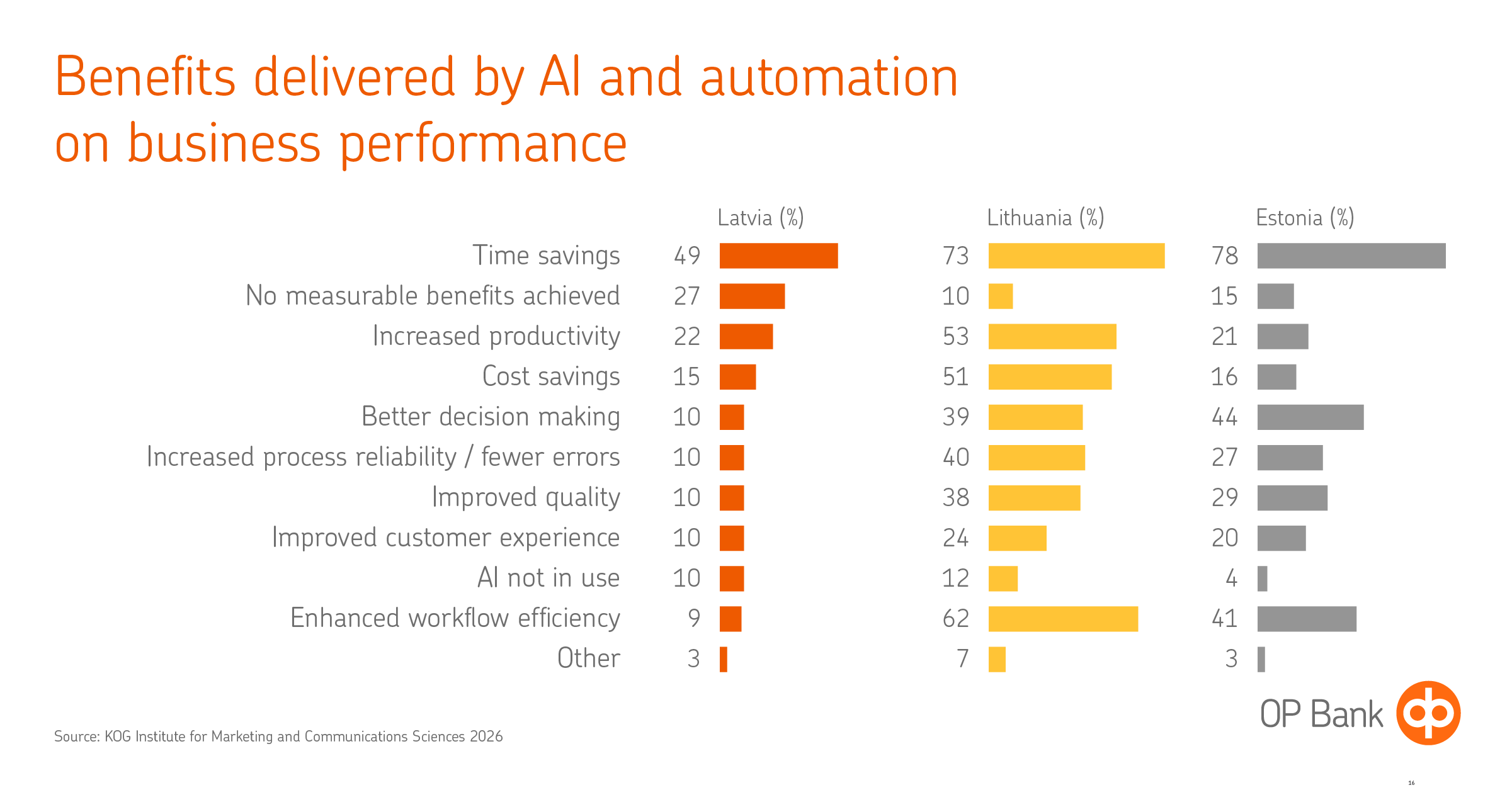
Across the Baltics, time savings stand out as the most significant benefit of AI and automation, cited by 49% of companies in Latvia, 73% in Lithuania and 78% in Estonia. In Latvia, AI and automation have helped 22% of companies increase productivity and 15% reduce costs. One in ten companies has also observed better decision-making processes, greater process reliability and fewer errors, as well as improvements in the quality of work or customer experience.
Lithuanian companies, in turn, report a broader range of benefits generated by AI and automation. 62% point to improved efficiency of work processes, 53% to increased productivity, 51% to cost savings and 40% to greater process reliability and fewer errors. In Estonia, alongside time savings, the impact of AI on decision-making stands out, with 44% of companies reporting improvements in this area.
Baltic data show that broader use of AI does not in itself mean greater measurable benefits. In Latvia, a larger share of companies use AI for basic tasks and tools than in Lithuania and Estonia, yet 27% of Latvian companies indicate that AI and automation have not yet delivered measurable results for them.
Finland’s experience: widespread use of AI does not yet guarantee business growth
Finland is one of the European leaders in the use of artificial intelligence. In 2025, AI technologies were used by 38% of Finnish companies with at least ten employees, the second-highest rate in the European Union after Denmark. However, widespread use of AI does not always translate into measurable business value.
OP Pohjola’s Yrityspulssi survey shows that large Finnish companies’ work with AI is mainly focused on improving existing operations. Only 22% of the companies surveyed focus more on business growth than on improving the efficiency of internal operations when using AI. Furthermore, only 15% of companies indicate that they are able to reliably measure the impact of AI on business results, although 48% say they know what business value they want to create with AI.
“Finland’s example is also interesting for Baltic companies. It shows that a high level of technology adoption is not in itself the end goal. A company needs a clear objective: what problem are we solving with AI, what result do we want to achieve, and what indicators will we use to assess whether the investment has paid off. Otherwise, we may be very active in introducing new tools but still be unable to say what value they actually create for the company,” emphasises Elmārs Prikšāns.
* The survey was commissioned by OP Corporate Bank and conducted by the market research and communication sciences institute KOG Institute for Marketing and Communications Sciences, surveying more than 300 representatives of medium-sized and large companies in the Baltics in April 2026.
** The “Yrityspulssi” survey was commissioned by OP Pohjola and conducted in Finland by Taloustutkimus Oy, surveying 100 representatives of large companies in May–June 2026.
*** The survey was commissioned by OP Corporate Bank and conducted by the market research company Rait, surveying more than 300 representatives of companies from various industries in the Baltics in February 2025.